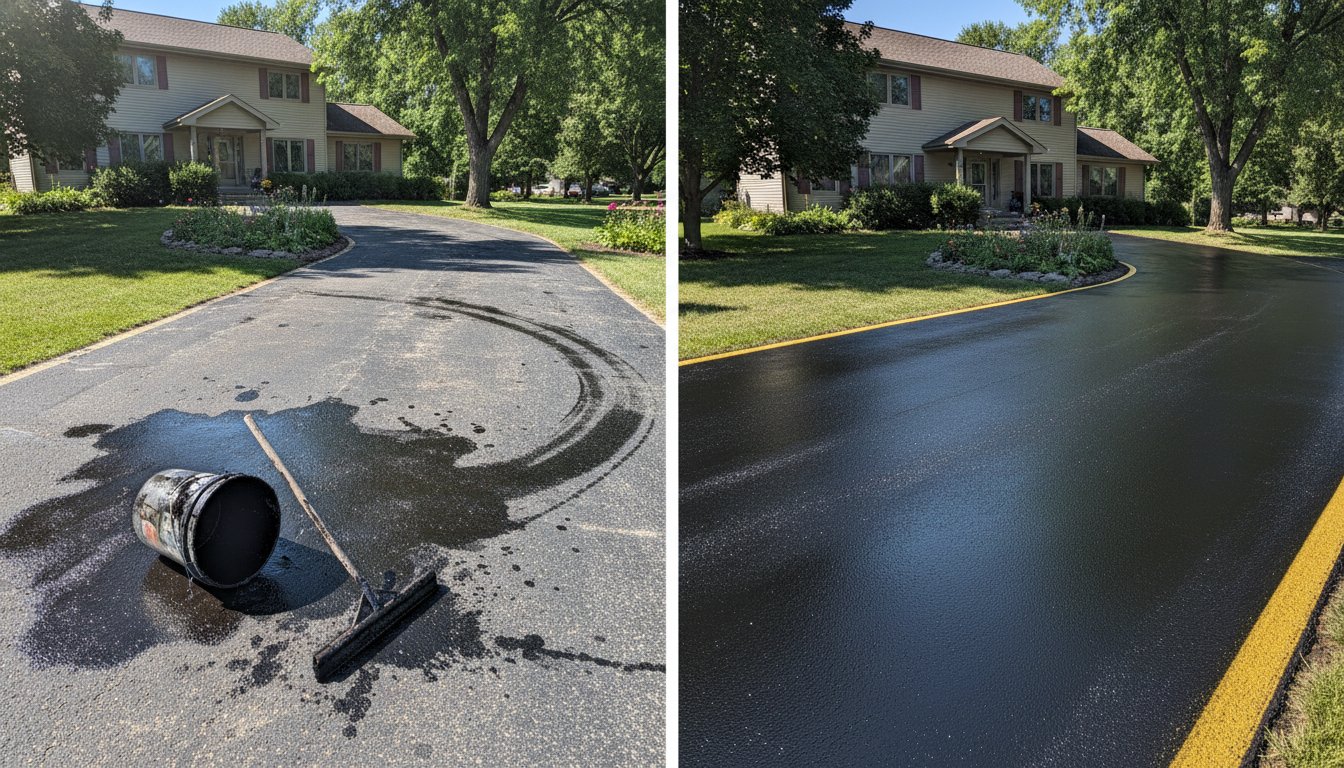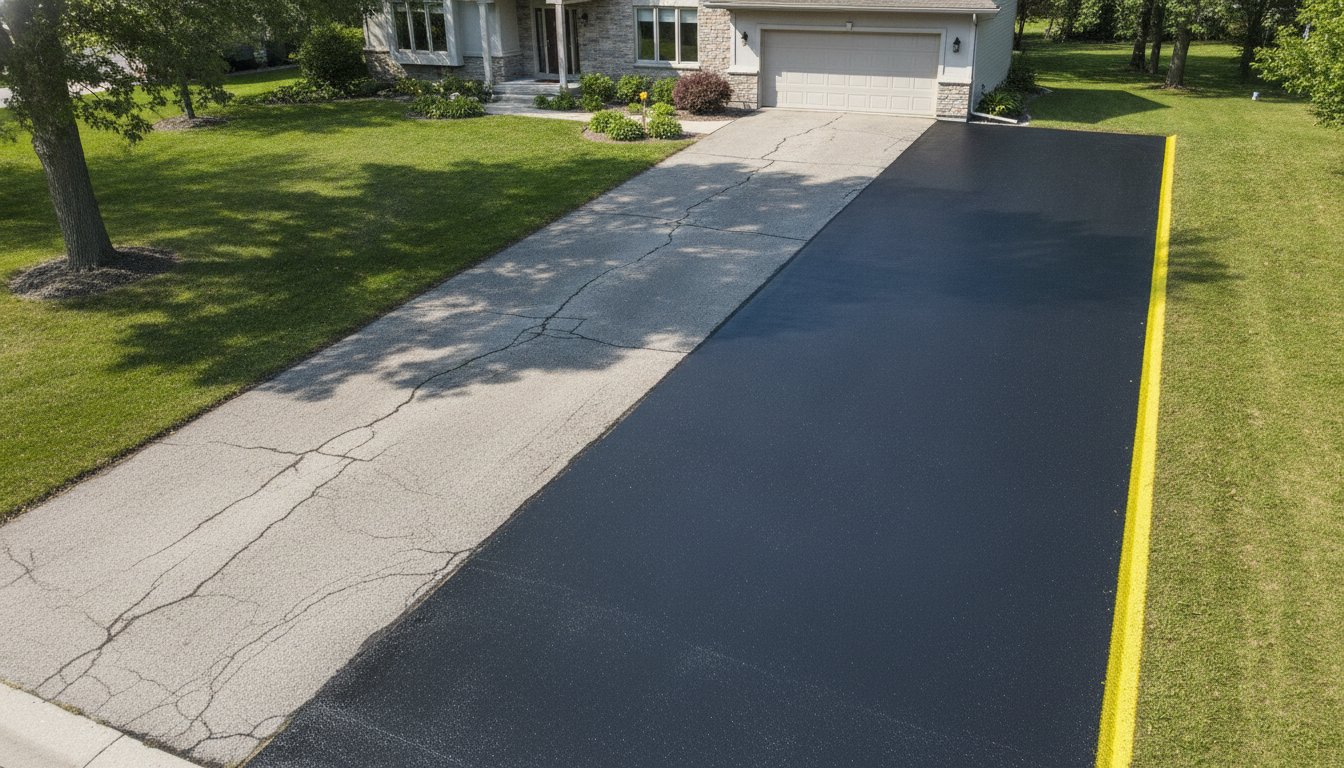
If you choose the cheapest quote for your driveway this season, you might end up paying for it twice before the first snow melts in April. It is frustrating to receive wildly different estimates for the same stretch of asphalt, especially when seasonal workers use aggressive tactics to pressure you into a quick decision. You want a fair price, but you also need a sealer that won't peel away after its first encounter with a Minnesota winter. When you're evaluating the driveway sealing cost in St. Paul, it's essential to remember that true affordability is measured by the years of protection you gain rather than just the initial price tag.
This 2026 guide is designed to provide the educational reassurance you need to navigate these quotes with confidence. We'll help you look past the surface numbers to discover the real factors behind local pricing so you can secure the best long-term value for your property. You'll learn exactly what drives the cost of professional maintenance, how to spot the difference between a quick fix and a durable application, and how to choose a specialist who understands the unique demands of our regional climate. By the end of this article, you'll have a clear framework for protecting your asphalt investment for years to come.
Key Takeaways
- Understand how surface area and the current state of your pavement dictate your estimate so you can avoid surprises when reviewing your quote.
- Learn how to calculate the long-term ROI of preventative care and why avoiding the "freeze-thaw tax" is the best way to manage your driveway sealing cost in St. Paul.
- Discover the technical differences between commercial-grade emulsions and retail buckets to ensure your protective layer survives more than one season.
- Identify the specific temperature requirements and seasonal windows in St. Paul that are critical for a successful, long-lasting cure.
- See why specialized tools like hot-rubber crack filling equipment provide a level of restoration that standard DIY methods simply cannot achieve.
Factors That Determine Driveway Sealing Cost in St. Paul
Understanding your estimate starts with looking at your pavement as a unique asset rather than just a flat surface. Several variables dictate the final driveway sealing cost in St. Paul, ranging from the obvious size of the lot to the hidden density of the soil beneath it. Local neighborhoods like Highland Park or Como Park often deal with heavy clay soils that trap moisture, leading to more frequent shifting and surface stress. This environmental pressure means that a driveway in St. Paul might require more intensive preparation than one in a region with sandier soil.
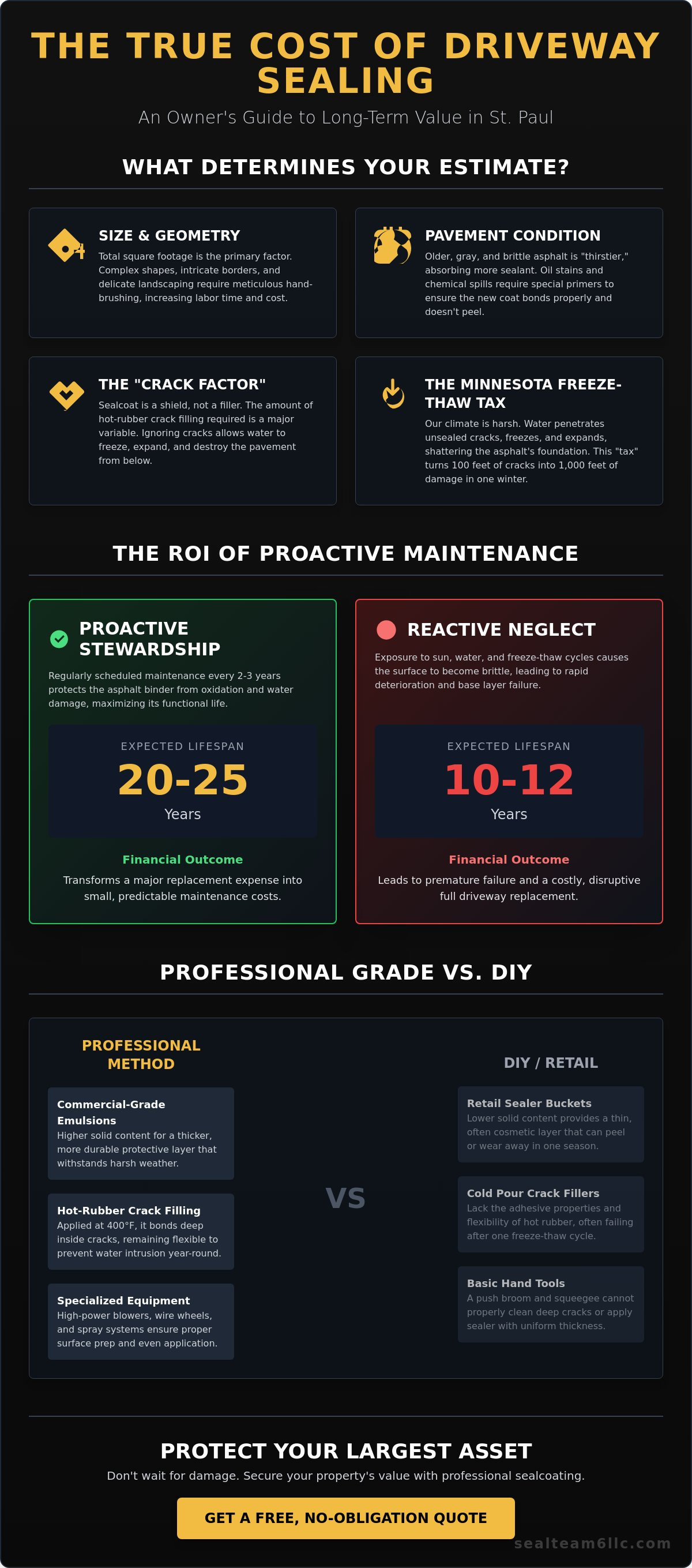
Condition matters just as much as size. Older pavement that has turned gray and brittle is more "thirsty," meaning it absorbs more material than a driveway that has been regularly maintained. If you have oil stains from a leaking vehicle or chemical spills from winter de-icers, these spots require specialized primers. Without these primers, the new sealer won't bond to the asphalt, leading to premature peeling. Accessibility also plays a role; if a crew has to navigate steep inclines or restricted entry points, the additional labor will be reflected in your driveway sealing cost in St. Paul.
Square Footage and Surface Geometry
Larger driveways usually benefit from a lower cost per square foot because the fixed expenses of mobilizing equipment and crew are spread across a bigger area. However, "cut-ins" significantly impact labor time. If your driveway has intricate borders against stone pavers, delicate landscaping, or complex sidewalk transitions, it requires meticulous hand-brushing. This precision work ensures that the sealer stays on the asphalt and off your decorative stonework. You can calculate a rough estimate by multiplying the length of your driveway by its average width to find the total square footage before you call for a professional quote.
The "Crack Factor" in St. Paul Pricing
The amount of hot-rubber crack filling needed is often the most variable part of a maintenance estimate. Sealcoating acts as a defensive shield, but it cannot bridge structural gaps on its own. While hairline cracks are common as asphalt ages, wider structural gaps allow water to penetrate the base layer. In our climate, this water expands as it freezes, literally lifting the asphalt from below and causing it to crumble. Ignoring 100 feet of cracks in St. Paul leads to 1,000 feet of damage after one winter. Addressing these gaps early is the only way to prevent a full driveway replacement.
The ROI of Professional Sealcoating: Why Affordable Means Protective
When evaluating the driveway sealing cost in St. Paul, homeowners often focus on the immediate expense. However, the real value lies in the thousands of dollars you avoid spending on structural paving later. Think of sealcoating as a defensive barrier rather than just a cosmetic upgrade. Without it, the binder in your asphalt begins to oxidize and break down as soon as it's exposed to the elements. This chemical decay makes the surface brittle and prone to failure under the weight of standard passenger vehicles.
A well-maintained driveway does more than just protect the ground; it anchors the curb appeal of your entire home. In the competitive St. Paul real estate market, a gray, crumbling driveway sends a signal of deferred maintenance to potential buyers. Keeping your asphalt in top condition ensures your property value remains high while keeping your total driveway sealing cost in St. Paul as low as possible over the life of the home. If you're noticing your asphalt is starting to turn gray, it's the perfect time to consult with a local specialist about a protection plan.
Stewardship vs. Neglect: A 15-Year Comparison
Without regular care, a typical residential driveway in the Twin Cities rarely survives more than 10 to 12 years before the base layer fails and requires a full replacement. In contrast, a property owner who invests in regular maintenance every two to three years can easily extend that lifespan to 20 or 25 years. This proactive approach shifts your spending from expensive emergency repairs to manageable maintenance cycles. For a deeper look at these long-term benefits, you can explore our Sealcoating Services in Minnesota: The Complete 2026 Property Owner’s Guide.
Battling the Minnesota Freeze-Thaw Cycle
Our local weather is uniquely aggressive toward pavement. The "Freeze-Thaw tax" is a real financial burden for those who leave their asphalt unprotected. When water enters even the smallest hairline cracks, it expands during the freezing nights and contracts during the sunny days. This constant movement creates a hydraulic force that turns minor flaws into deep potholes by February.
UV rays also play a role by bleaching the asphalt and making it brittle. When the surface loses its flexibility, it can't withstand the weight of vehicles or the corrosive effects of road salt. According to the Minnesota Pollution Control Agency, choosing the right materials is vital for both environmental safety and long-term durability. By sealing these pores, you create a waterproof shield that resists chemical decay and keeps your driveway looking rich and black through the harshest winters.
Evaluating Quotes: Comparing Materials and Application Methods
When you receive three different estimates for your property, the variance in the driveway sealing cost in St. Paul can be startling. One contractor might be half the price of another, but this gap usually indicates a difference in material volume or preparation thoroughness. A professional quote should clearly outline the type of sealer used, the application method, and the specific steps taken to prepare the surface. You aren't just paying for a black driveway; you're paying for a chemical bond that stays put through a blizzard.
Many older sealants were coal-tar based, but modern standards have shifted toward asphalt emulsions. Research from the U.S. Geological Survey has highlighted the environmental and health considerations of coal-tar products, leading many local specialists to prefer safer, high-performance emulsion alternatives. These emulsions provide excellent UV protection and a deep black finish without the harsh odors or runoff concerns associated with older materials.
Another factor in your driveway sealing cost in St. Paul is the administrative protection the company provides. A reputable local specialist will be fully insured and bonded. This coverage ensures that if an accident happens on your property or material is accidentally sprayed on your stone siding, you aren't left holding the bill for the cleanup or medical costs. Always verify that your chosen contractor holds a valid local license before signing a contract.
Sealer Quality: What Are You Actually Buying?
The durability of your sealcoat depends heavily on the "solids content" of the mixture. Cheap, watered-down sealers might look great for a month, but they lack the necessary volume of asphalt and polymers to resist wear. When you're reviewing a quote, ask the contractor: "What is the solids content of your sealer?" A professional-grade emulsion typically contains about 40% to 50% solids. If the price seems too good to be true, the contractor might be over-diluting the material to save on their own costs, which results in a layer that washes away by spring.
The Prep Work: The Hidden Cost of Quality
Preparation is where most "bargain" crews cut corners. For a sealer to bond, the asphalt must be surgically clean. This requires high-powered blowers to clear debris and wire brushing to remove stubborn dirt from the pores of the pavement. Professional contractors also take the time to prime oil spots. Since sealer is water-based, it won't stick to oil or gas spills without a chemical bridge. Finally, edge-trimming ensures a crisp line along your grass and prevents the sealer from looking messy or unfinished. These labor-intensive steps are essential for a restoration that lasts.
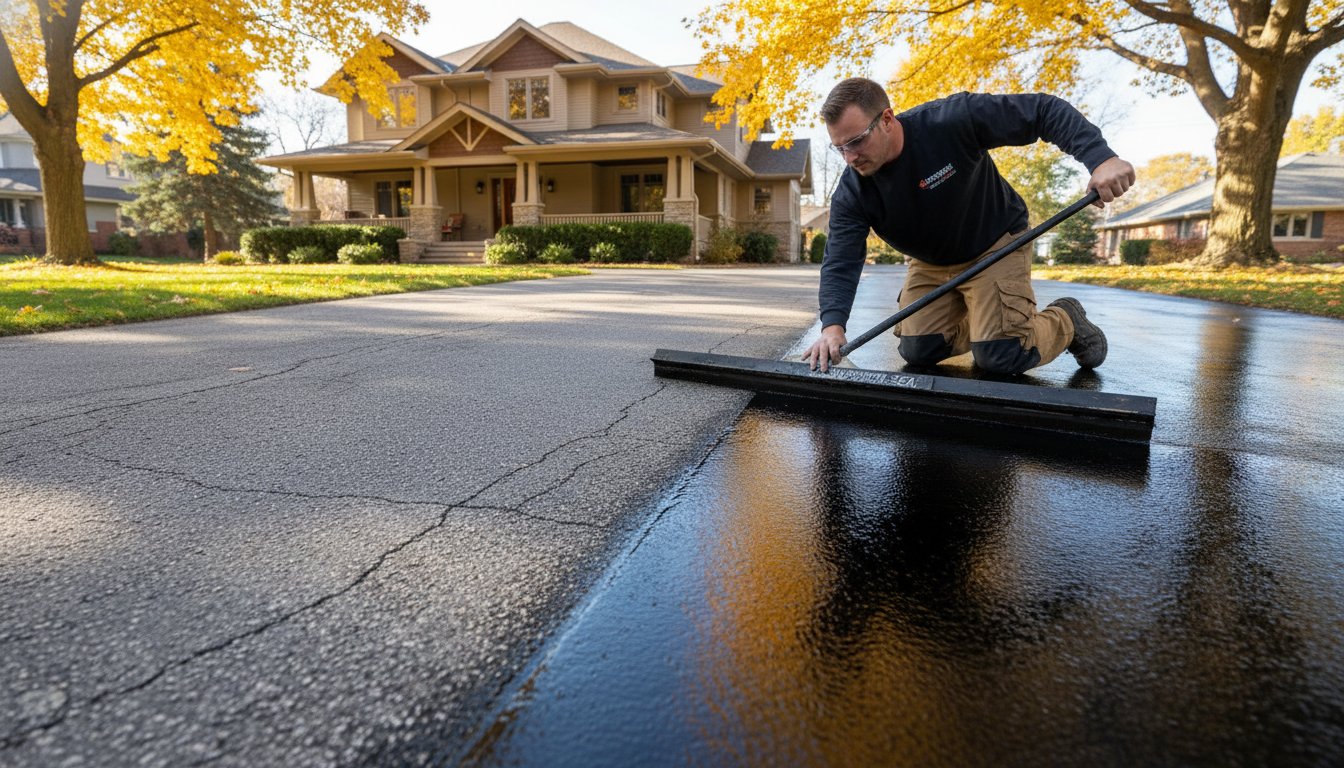
The Best Time to Sealcoat in St. Paul to Maximize Your Budget
Finding the right window for maintenance is about more than just your calendar. It's about the chemistry of the sealer itself. In our region, the driveway sealing cost in St. Paul is often most manageable when you schedule during the mid-summer "sweet spot." This period, typically running from late May through early September, offers the most predictable weather for a successful application. If you wait until the autumn rush in late September or October, you risk competing with every other homeowner in the Twin Cities. This high demand can lead to scheduling delays as contractors scramble to finish their lists before the ground freezes.
You can also help keep your costs down by preparing the site before the crew arrives. Ensure all vehicles are moved to the street, turn off automatic sprinklers 24 hours in advance, and clear any large debris or toys from the area. This preparation allows the specialists to begin the technical work immediately. When a crew doesn't have to spend an hour moving basketball hoops or waiting for a wet surface to dry, the job stays on schedule and within the original estimate.
Ideal Weather Conditions for Asphalt Curing
The drying process relies entirely on evaporation. For the sealer to transform from a liquid to a durable shield, the water must leave the mixture. High humidity can stall this process for hours, while direct sunlight helps by warming the asphalt surface and accelerating the bond. However, the most critical factor is the overnight temperature. If the thermometer drops below 50 degrees Fahrenheit before the sealer has fully cured, the chemical bond will fail. This failure often results in a dull finish that peels away within months, effectively wasting your investment.
- Rain Protection: A surprise rainstorm within four hours of application can wash the material into your lawn or drainage system.
- The 24-Hour Rule: While the surface might feel dry to the touch in a few hours, you must keep vehicles off the driveway for a full 24 hours to prevent tire marks.
Local Neighborhood Considerations: Highland Park to Como
Neighborhoods like Highland Park and Como Park present unique challenges due to their mature tree canopies. While the shade is pleasant, falling sap and heavy pollen act as "bond-breakers" if they aren't cleared immediately before application. On St. Paul’s East Side, we often address specific drainage issues where older driveways have settled near the garage apron. If your property has a steep incline or restricted access, please let us know so we can plan the application to avoid blocking street traffic. To get a precise look at your property's needs, request a professional site evaluation today.
Why Professional Care Beats DIY: The Seal Team LLC Difference
Many homeowners consider the DIY route to lower their driveway sealing cost in St. Paul. It seems straightforward: buy a few buckets, grab a squeegee, and spend a Saturday afternoon on the pavement. However, this approach often overlooks the technical requirements of lasting asphalt defense. Without commercial-grade equipment and specialized materials, you are likely applying a temporary cosmetic layer rather than a structural shield. True stewardship of your property requires a solution that lasts for years, not just until the next heavy rain.
Professional care relies on specialized tools that aren't available at your local hardware store. For instance, our hot-rubber crack filling process requires melting blocks of rubber at high temperatures to ensure the material flows deep into the gaps and bonds to the sidewalls. This creates a flexible, waterproof seal that moves with the pavement during Minnesota’s temperature swings. Standard cold-pour fillers from a bottle simply can't match this level of restoration. When you choose a local specialist, you're investing in the specialized equipment and experience necessary to preserve your driveway's foundation.
The Limitations of Big-Box Store Sealers
Retail sealers found in big-box stores are often formulated for ease of application rather than long-term durability. These products typically have a lower solids content and lack the high-performance polymers found in commercial emulsions. As a result, DIY projects frequently begin to flake or peel within 12 months of application. When you factor in the cost of brushes, rollers, specialized cleaning agents, and the inevitable ruined clothes, the "savings" of DIY quickly disappear. Professional application ensures a chemical bond, not just a surface coating.
Getting Your Free St. Paul Estimate Today
At Seal Team LLC, we view ourselves as partners in your property’s long-term health. We provide transparent, project-based pricing that reflects the actual needs of your asphalt rather than a generic flat rate. When evaluating your driveway sealing cost in St. Paul, we look at every factor from drainage patterns to crack density. This thorough assessment ensures that the quote you receive is accurate and focused on long-term value.
Our "No-Hassle" scheduling process is designed for busy Twin Cities homeowners who want reliable results without the aggressive sales tactics common in this industry. We prioritize honesty and transparency in every project. Contact us for a professional assessment of your asphalt and discover the peace of mind that comes with expert stewardship. We are ready to help you protect your investment with the care and precision it deserves.
Secure Your Asphalt Investment for the Years Ahead
Investing in your driveway is a commitment to the long-term stewardship of your home. The true driveway sealing cost in St. Paul is determined by the quality of the bond and the thoroughness of the preparation rather than just the lowest bid. By choosing high-solids emulsions and ensuring structural gaps are addressed with professional-grade hot rubber crack filling, you prevent the harsh Minnesota freeze-thaw cycle from turning minor flaws into costly structural failures. Our local, family-owned business specializes in providing the resilient protection your asphalt needs to survive our unique climate.
Don't wait for the next winter to reveal the weaknesses in your pavement. We're here to help you navigate your maintenance options with honesty and technical expertise. You can Get Your Free St. Paul Driveway Sealing Estimate today to receive a transparent assessment of your property's specific needs. Taking proactive steps now ensures your driveway remains a durable and attractive asset for your home for many years to come.
Frequently Asked Questions
Is driveway sealing worth the cost in St. Paul?
Yes, sealcoating is a necessary form of stewardship for your property's investment. By creating a waterproof barrier, you prevent the aggressive Minnesota freeze-thaw cycle from destroying the asphalt's base layer. The driveway sealing cost in St. Paul is a smart investment when compared to a full driveway replacement, which can cost thousands of dollars. It also preserves the curb appeal and resale value of your home in competitive local neighborhoods.
How much does it cost to seal a 2-car driveway in the Twin Cities?
The total driveway sealing cost in St. Paul depends primarily on the square footage and the current condition of your asphalt. While a standard two-car driveway usually falls within a predictable range, factors like intensive crack filling or oil spot priming will adjust the final quote. Most local specialists provide project-based pricing rather than flat rates to ensure you only pay for the specific materials and labor your property requires.
How often should I sealcoat my driveway in Minnesota?
You should generally sealcoat your driveway every two to three years to maintain optimal protection. This frequency ensures the asphalt remains flexible and resistant to UV oxidation and chemical spills. If your driveway experiences heavy traffic or shows signs of graying and brittleness sooner, you might consider a more frequent maintenance schedule. Regular applications prevent the binder from breaking down and keep the surface resilient against winter road salts.
Can I sealcoat my driveway myself to save money?
While DIY kits are available, they often lack the durability of commercial-grade emulsions. Residential-grade buckets from big-box stores frequently flake within a single season because they don't form a deep chemical bond with the existing asphalt. Additionally, homeowners lack the specialized equipment required for hot-rubber crack filling, which is essential for stopping water penetration. Hiring a specialist ensures a professional finish that survives the harsh local climate.
How long does driveway sealer take to dry in St. Paul weather?
Driveway sealer typically takes about 24 hours to cure fully before it can support vehicle traffic. In the humid or cooler conditions often found in St. Paul, this window is critical to ensure the material doesn't track or scuff. You can usually walk on the surface after four to six hours, but you should keep cars, heavy equipment, and lawnmowers away for the full first day to allow the chemical bond to set properly.
Does sealcoating fix cracks in my driveway?
Sealcoating is a protective surface layer and is not designed to fill or structuralize existing cracks. While it provides a waterproof shield for the entire surface, any gaps wider than a hairline must be addressed with professional crack filling before the sealer is applied. Applying sealer over open cracks without filling them first is a temporary cosmetic fix that won't stop water from reaching the base layer and causing further damage.
What is the difference between crack filling and crack sealing?
Crack filling involves placing a material into non-working cracks to reduce water infiltration and reinforce the pavement. Crack sealing is a more advanced method used for cracks that expand and contract with temperature changes, often utilizing hot-applied rubberized materials. For St. Paul homeowners, professional crack filling with hot-applied rubber is the standard for long-term defense because it remains flexible during our sub-zero winters.
What happens if it rains right after my driveway is sealed?
If it rains within four hours of application, the water can wash the uncured sealer off the asphalt and into your landscaping. This not only ruins the finish but also wastes the protective materials. Professional contractors monitor local weather closely and will reschedule your service if there is a significant risk of rain. If a surprise storm occurs, the affected areas will likely need to be cleaned and reapplied to ensure the protective barrier is intact.