Your asphalt isn't just a driveway; it's a multi-thousand-dollar asset currently being eroded by Minnesota's brutal freeze-thaw cycles. It's frustrating to watch a smooth, black surface turn gray and brittle after just a few winters. We understand the confusion that comes with conflicting advice, especially when you're trying to avoid the high cost of a total replacement. You shouldn't have to guess which repairs are necessary and which are just hype. You deserve a logical, expert-led strategy to protect your property's value.
This article provides a professional-grade 2026 asphalt maintenance schedule designed specifically for the Twin Cities' extreme climate. By following this timeline, you'll master the art of pavement stewardship and maximize the 20 to 30 year lifespan of your surface. We'll walk you through a multi-year plan that covers everything from seasonal inspections to the critical timing for crack filling and seal coating. You'll learn how to identify structural risks before they become potholes, ensuring your pavement remains durable and attractive through the harshest winter elements.
Key Takeaways
- Identify your pavement's current life stage to determine whether it requires initial curing support or restorative mid-life care.
- Establish a proactive asphalt maintenance schedule to prevent Minnesota's freeze-thaw cycles from turning minor surface cracks into structural failures.
- Learn to perform a visual audit to spot "bony" textures and color shifts that signal your asphalt is losing its essential, flexible oils.
- Understand the technical advantages of industrial-grade hot-pour rubberized sealants over standard consumer-grade liquid fillers.
- Discover how local soil conditions in the Twin Cities influence the specific timing and frequency of professional seal coating and crack filling.
The Life Cycle of Asphalt: Why a Schedule Matters
Asphalt is a sophisticated mixture of stone, sand, and a bitumen binder that acts as the "glue" holding everything together. Unlike concrete, which is rigid, asphalt is a flexible pavement. This flexibility is its greatest strength, allowing it to expand and contract during the Twin Cities' extreme temperature swings. However, that resilience depends entirely on the health of the oils within the binder. Without a proactive asphalt maintenance schedule, those oils evaporate, leaving the surface brittle and prone to failure.
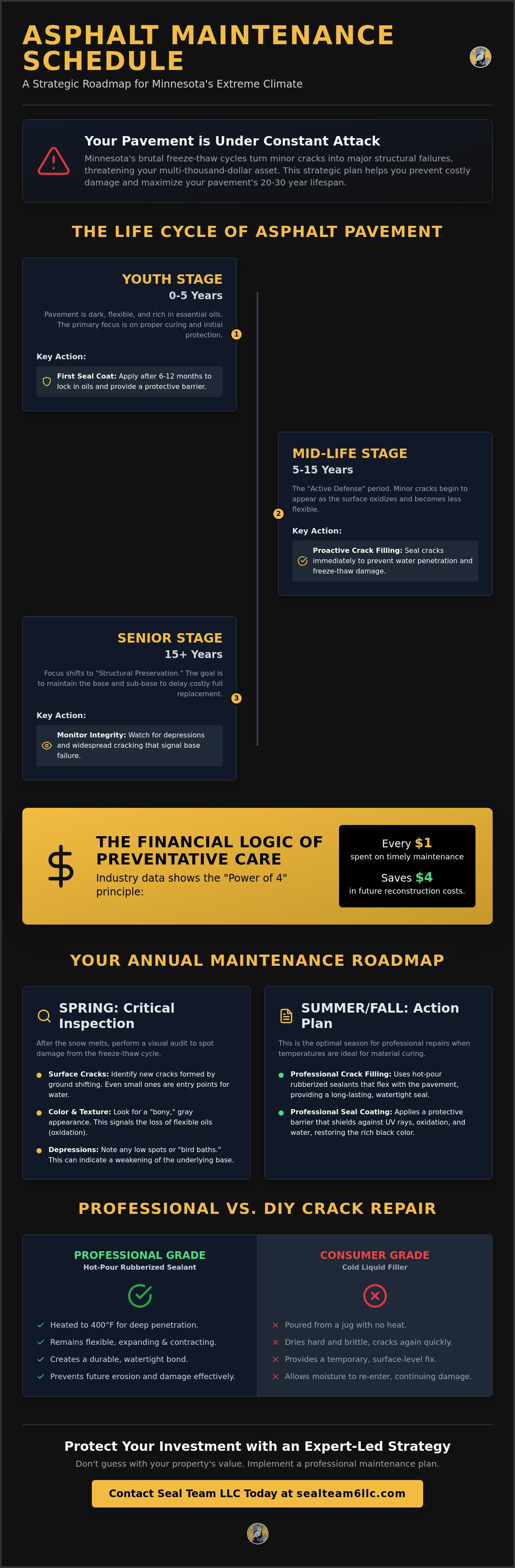
Understanding the three distinct stages of an asphalt surface's life helps property owners make better decisions. During the Youth stage (0-5 years), the pavement is dark, flexible, and requires its first protective layer once it has fully cured. The Mid-life stage (5-15 years) is the "Active Defense" period where minor cracks begin to surface and require immediate attention. Finally, the Senior stage (15+ years) focuses on structural preservation. At this point, the goal is to keep the base stable to avoid a total reconstruction.
Adopting a systematic Pavement management system isn't just for city engineers; it's a vital tool for any property owner. By viewing your driveway or parking lot as a long-term asset, you move from reactive repairs to strategic stewardship. This shift in mindset prevents the structural decay that leads to potholes and foundation failure.
The "Graying" Effect and Material Decay
When asphalt is first laid, it's a rich, deep black. This color comes from the bitumen binder. Over time, UV radiation and oxygen attack the pavement's molecular structure in a process called oxidation. This chemical change causes the binder to lose its adhesive properties. You'll notice the surface turning a dull, weather-beaten gray. This isn't just an aesthetic issue; it's the first sign that the pavement is becoming brittle. Homeowners often miss the subtle "raveling" that follows, where small pebbles and sand begin to break loose because the glue can no longer hold them in place.
The Financial Logic of Preventative Care
The cost difference between maintenance and replacement is staggering. A total dig-out and repave is a major capital expense that most owners want to delay as long as possible. Professional seal coating and crack filling act as a protective barrier, shielding the binder from the elements. In the industry, we often refer to the "Power of 4" rule. This principle suggests that every $1 you spend on timely maintenance saves approximately $4 in future reconstruction costs. For a deeper look at the long-term value of these services, consult our Minnesota property owner’s guide. Investing in your asphalt maintenance schedule today ensures you aren't paying for a new driveway years before it's actually necessary.
Your 2026 Asphalt Maintenance Calendar: A Chronological Roadmap
Minnesota's weather isn't just a challenge; it's a constant physical assault on your pavement. To combat the unique thermal expansion found in the Twin Cities, you need a calendar that reflects the actual aging process of asphalt in our region. A generic asphalt maintenance schedule often fails because it doesn't account for the 200 plus road construction projects MnDOT plans annually or the specific seasonal limitations of our state.
The first two years of a new surface are critical for long-term health. New asphalt is rich in virgin oils that make it flexible. However, these oils need time to cure out so the pavement can harden properly. Typically, we recommend waiting 6 to 12 months before the first application of seal coating. This initial treatment locks in those remaining oils before the first major oxidation cycle begins.
As the pavement enters the "Active Defense" phase between years 3 and 10, the focus shifts to preventing water penetration. The Federal Highway Administration's Pavement Preservation Guide highlights that timely intervention is significantly more cost-effective than major reconstruction. In Minnesota, this means inspecting your surface every spring after the snow melts to identify new cracks formed by the ground shifting. Between years 10 and 20, you enter the "Restoration" phase. While seal coating still provides surface protection, we monitor closer for structural integrity issues like depressions that suggest the underlying base is weakening.
The First 24 Months: Setting the Foundation
Don't rush the first sealcoat. Brand-new asphalt needs to weather through at least one full summer to allow light oils to escape. If you apply a sealant immediately, you risk creating a surface that stays tender for too long. Once that curing window closes, usually around the 12-month mark, the first professional application becomes essential to defend the binder from road salt and UV rays. This is also the best time to perform an initial crack audit.
The 3-Year Recurring Cycle
For most properties, a three-year cycle is the gold standard for a successful asphalt maintenance schedule. This includes deep cleaning, professional crack filling, and a fresh sealcoat overlay. Skipping a cycle is a gamble because road salt accelerates the breakdown of the bitumen binder. Business owners can find more details on budgeting these costs in our guide on commercial asphalt maintenance plans.
Timing is everything in the North Star State. Because MnDOT Specification 2360 effectively limits hot-mix work to when temperatures are above 40°F, our window is strictly restricted to May through September. If you're noticing graying or small cracks, it's a good idea to get a professional assessment before the next winter freeze sets in.
Critical Inspection Checklist: Detecting Minnesota Weather Damage
Regular visual assessments are the backbone of any effective asphalt maintenance schedule. In Minnesota, these inspections are most productive in early spring, right after the snow melt reveals the winter's toll. You're looking for specific indicators of material fatigue. Start with the surface texture. If the pavement feels "bony" or rough, it means the fine sand and bitumen binder are loosening. This exposure is often worsened by heavy applications of road salt, which accelerates the disintegration of the top layer much faster than UV rays alone.
The color of your pavement also tells a story. While a "clean gray" indicates natural, manageable oxidation, a "weather-beaten white" appearance suggests the oils are nearly gone and the stones are fully exposed. You should also check for "birdbaths," which are shallow depressions where water pools. Standing water is a primary enemy of asphalt because it eventually seeps through the surface to soften the sub-base. If you see weeds or grass growing through the pavement, it's a clear signal that moisture has already penetrated the entire structure and reached the soil beneath, compromising the foundation.
The "Quarter-Inch" Rule for Cracks
Cracks are inevitable in our climate, but their size determines the level of urgency. Any gap wider than a quarter-inch is considered a maintenance emergency in the North Star State. These openings allow water to reach the gravel base. During the freeze-thaw cycle, this trapped water expands as it turns to ice, exerting massive pressure that rips the asphalt apart from the inside. Hairline surface checks might be cosmetic for a season, but deep structural fissures require immediate crack filling to prevent a total collapse during the next frost.
Identifying Raveling and Alligator Cracking
It's vital to distinguish between surface wear and structural failure to manage your asphalt maintenance schedule effectively. Raveling is the progressive disintegration of the pavement surface from the top down. While raveling can often be slowed with professional seal coating, "Alligator Cracking" is a more serious issue. These interconnected cracks resemble the scales of a reptile and indicate that the underlying base has failed. It's a hard truth for property owners, but sealcoating cannot fix alligator cracks. These areas require professional patching to restore the integrity of the lot before the damage spreads to healthy sections of pavement.
Professional Crack Filling vs. DIY: A Strategic Comparison
Maintaining a property in the Twin Cities requires a realistic approach to the materials and methods used. Many property owners are tempted by off-the-shelf DIY kits, but these consumer products often lack the chemical properties needed to survive a Minnesota winter. Professional crack filling relies on industrial-grade hot-pour rubberized sealant. This is a fundamentally different material than the thin liquid fillers found at big-box stores, which often lack the binder density to stay bonded during a deep freeze.
Preparation is the stage where most DIY efforts fail. A professional crew doesn't just pour material into a gap. We utilize specialized equipment, including wire brushes and heat lances, to prepare the area. The heat lance is particularly vital; it removes deep-seated moisture and kills vegetation roots while slightly warming the asphalt to ensure a thermal bond. Without this meticulous cleaning, any sealant you apply will simply sit on top of dirt and debris, eventually peeling away when the ground shifts. Incorporating these high standards into your asphalt maintenance schedule is what separates a temporary fix from a long-term defense.
Safety is another factor that shouldn't be overlooked. Industrial sealants must be heated to approximately 400 degrees Fahrenheit in a specialized melter to reach the correct viscosity. Handling these high-heat materials without professional-grade kettles and protective gear poses significant physical risks. For most owners, the liability and potential for injury far outweigh the perceived savings of a weekend project.
Why "Hot-Pour" is Essential for Minnesota
The primary advantage of hot-pour rubber is its elasticity. In our climate, pavement is constantly moving. Hot-pour sealant is designed to remain flexible even in sub-zero temperatures, stretching and contracting along with the asphalt. Contrast this with "cold-patch" or liquid fillers that become brittle and crack when the thermometer drops. When these inferior materials fail, they leave your base exposed to the very water damage you were trying to prevent. To see how this fits into the larger service process, you can refer to our guide on what to expect during sealcoating.
The Hidden Costs of DIY Failure
A failed DIY attempt often creates more work for a professional down the road. If a gap is filled with low-quality liquid filler that later cracks, that material must be laboriously cleaned out before a commercial-grade sealant can be applied. Furthermore, improper sealing can trap moisture beneath the filler, which accelerates internal rot and softens the sub-base. A single application of professional hot-pour sealant typically lasts five years or more, whereas DIY liquid fillers rarely survive a single Twin Cities frost cycle. If you want to ensure your pavement is truly protected, contact us for a professional crack filling assessment to get it done right the first time.
Implementing Your Maintenance Plan with Seal Team LLC
Execution is the final step in securing your pavement's future. At Seal Team LLC, we don't believe in a one-size-fits-all approach. Every asphalt maintenance schedule we develop is customized to the specific environmental conditions of your property. For example, properties in Minneapolis often sit on sandier soils that drain well, while parts of Saint Paul contend with heavy clay that holds moisture. These geological differences dictate how aggressively we must manage water runoff and how frequently your surface requires professional intervention.
Our "No-Pressure" estimate process is designed to be educational rather than transactional. When our technicians visit your site, they perform a comprehensive audit of your pavement's current health. We look for subtle signs of distress that often go unnoticed, such as sub-base softening near drainage catch basins or early-stage oxidation. By coordinating professional crack filling with a high-grade sealcoat application, we provide a dual-layer defense that restores the deep black finish of your asphalt while sealing out the elements. This proactive strategy ensures your property maintains peak curb appeal while avoiding the structural failures that lead to expensive repaving projects.
Residential vs. Commercial Scheduling Needs
We understand that the logistics of a project are just as important as the materials used. For our commercial clients, we focus on strategic traffic flow management. We can phase out parking lot sections to ensure your business remains accessible to customers during the application. For homeowners, our priority is minimizing downtime. We work efficiently to ensure your driveway is back in service as quickly as possible without compromising the curing process. Regardless of the property type, expert driveway crack filling remains the most critical step for local owners. It's the only way to stop the internal erosion that turns a small gap into a major pothole.
Our Stewardship Commitment
Our philosophy is rooted in "Defense First" pavement preservation. We view ourselves as the diligent guardians of your investment, providing the technical expertise needed to navigate Minnesota's challenging climate. Local reliability is the cornerstone of our business; we understand the unique pressures that Twin Cities weather puts on your asphalt because we live and work in the same environment. We take pride in helping our neighbors avoid future headaches through honest assessments and long-term results.
The 2026 spring inspection season is approaching, and our calendar fills up quickly as the temperatures rise. Taking action now allows you to secure your place in our asphalt maintenance schedule before the peak summer demand. Don't wait for a minor crack to become a major liability. Get your free asphalt maintenance estimate from Seal Team LLC today.
Securing Your Pavement's Future in 2026
Maintaining your asphalt in the Twin Cities isn't about quick fixes; it's about a commitment to long-term stewardship. By implementing a proactive asphalt maintenance schedule, you've taken the first step toward avoiding the high costs of premature reconstruction. You now understand how to spot the early signs of oxidation and why industrial-grade hot-pour crack sealing is essential for surviving our local freeze-thaw cycles. These strategic interventions act as a necessary defense, preserving the flexibility and durability of your surface for decades.
Seal Team LLC specializes in Minnesota freeze-thaw protection. We offer free professional site inspections to help you identify structural risks before they escalate. Our team uses industrial-grade hot-pour rubberized materials to ensure your repairs move with the ground rather than popping out during the first frost. Take the guesswork out of property management and partner with a local specialist who understands our unique environmental challenges. Request Your Free 2026 Asphalt Maintenance Estimate today. We look forward to helping you protect your investment and maintain your property's curb appeal for years to come.
Frequently Asked Questions
How often should I sealcoat my driveway in Minnesota?
You should ideally sealcoat your driveway every two to three years to maintain a protective barrier against the elements. This frequency is a core component of a professional asphalt maintenance schedule in the Twin Cities. Regular applications replenish the essential oils that keep the pavement flexible, preventing it from becoming brittle and prone to cracking during the winter.
What is the best month to schedule asphalt maintenance?
The best months for maintenance are May through September when temperatures remain consistently above 40 degrees Fahrenheit. This window aligns with MnDOT standards for asphalt application. Scheduling during these warmer months ensures that materials like seal coating and hot-pour rubberized sealant can bond and cure correctly before the first frost.
Can I fill asphalt cracks myself or should I hire a pro?
While DIY kits are available, hiring a professional is recommended for the use of industrial-grade hot-pour rubberized sealant. Consumer-grade liquid fillers often lack the elasticity to survive Minnesota's freeze-thaw cycles and frequently pop out after one winter. Professionals also use specialized equipment like heat lances to ensure the crack is clean and dry before application.
How long does a professional sealcoating application last?
A professional sealcoating application typically lasts between two and four years. The exact lifespan depends on the volume of vehicle traffic and the severity of the weather cycles. Regularly following your asphalt maintenance schedule ensures that you reapply the sealant before the underlying binder begins to oxidize and turn gray.
What happens if I skip asphalt maintenance for a few years?
Skipping maintenance leads to rapid oxidation and water penetration into the gravel base. Without crack filling and seal coating, water enters the structure, freezes, and expands, which creates potholes and alligator cracking. Over time, this neglect causes the sub-base to soften, eventually requiring a total and expensive repaving of the surface.
Does road salt damage my asphalt sealcoating?
Yes, road salt is highly corrosive and accelerates the degradation of the bitumen binder in your asphalt. Sealcoating acts as a sacrificial barrier, taking the brunt of the salt damage so the actual pavement remains protected. It is important to wash off excess salt in the spring to extend the life of your sealant.
What is the difference between crack filling and crack sealing?
Crack filling involves putting material into stationary cracks, while crack sealing uses flexible, hot-pour rubber for "working" cracks that expand and contract. In Minnesota, almost all cracks are considered working cracks due to the extreme temperature swings. Professional sealing is required to ensure the repair moves with the pavement without breaking the bond.
How long do I need to stay off my driveway after sealcoating?
You should generally wait at least 24 to 48 hours before driving a vehicle onto a freshly sealcoated surface. While the sealant may feel dry to the touch within a few hours, it requires a full day or more to cure deeply enough to handle the weight and friction of tires. Pedestrians should also stay off the area for at least 4 to 8 hours to prevent tracking.