Asphalt maintenance isn't just a cosmetic face-lift for your property; it is a critical chemical defense strategy designed to preserve your pavement's structural integrity. You've likely felt the frustration of watching a fresh coat of sealant peel away after just one winter, or perhaps you're tired of aggressive door-to-door sales tactics from unverified contractors. It's exhausting to try and distinguish between a "fly-by-night" operation and a legitimate asphalt maintenance company that truly understands the unique demands of the Minnesota climate.
You deserve a driveway or parking lot that remains durable for 20 years or more, not a temporary fix that fails under the pressure of road salt and moisture. This guide will show you how to identify a high-quality partner that uses high-solids sealants and deep crack filling to maximize your ROI. We'll explore the specific markers of professional-grade work and provide a roadmap for finding a local specialist who prioritizes long-term results over quick, low-quality fixes.
Key Takeaways
- Understand why a specialized asphalt maintenance company produces longer-lasting results than a general paving contractor by using dedicated equipment for sealcoating and crack filling.
- Learn the technical difference between industrial-grade, high-solids sealants and the watered-down "budget" alternatives that often fail after a single Minnesota winter.
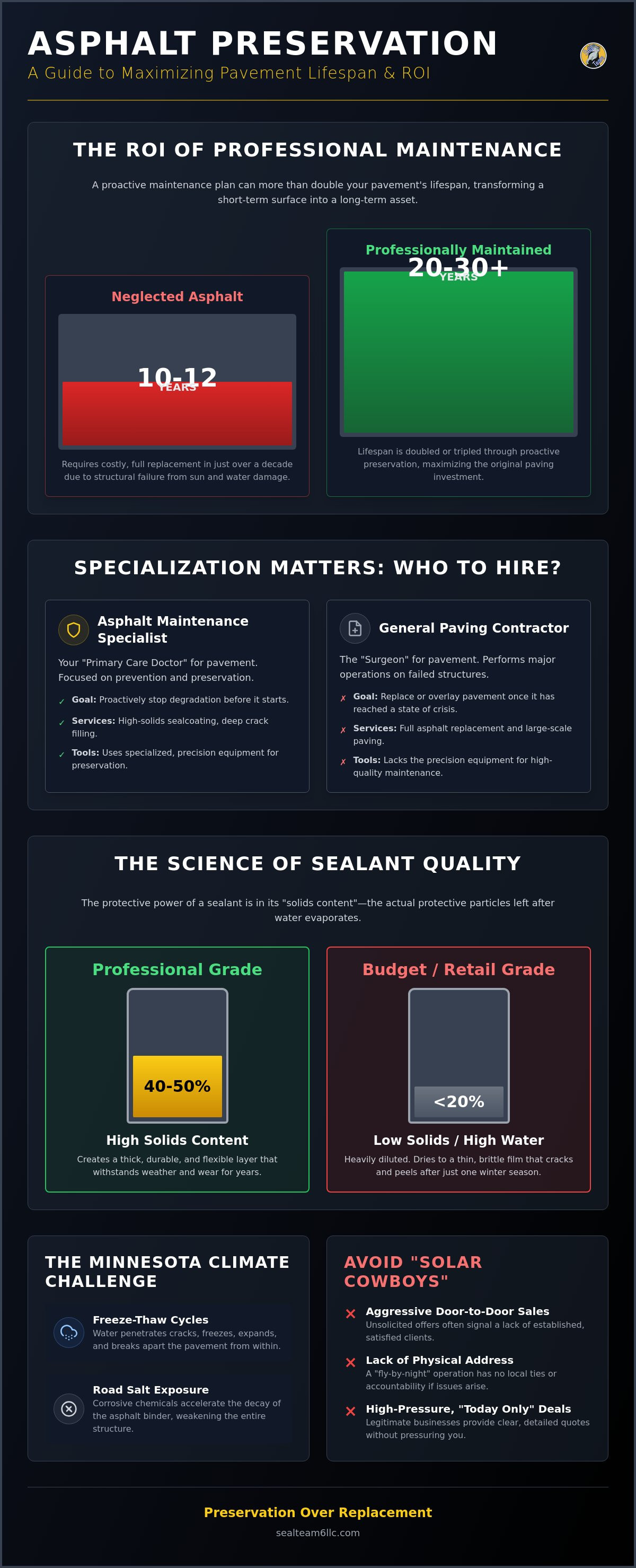
- Discover how the local freeze-thaw cycle and road salt exposure accelerate pavement decay, making protective maintenance a chemical necessity rather than a cosmetic choice.
- Identify the specific red flags of "Solar Cowboy" contractors, such as door-to-door solicitation and lack of a physical business address, to protect your property investment.
- Gain a roadmap for proactive stewardship that can extend your pavement's lifespan to 20+ years, ensuring you get the maximum ROI from your asphalt.
What is an Asphalt Maintenance Company and Why Specialization Matters?
Asphalt maintenance is a proactive preservation service focused on chemical and structural defense. While many property owners view their driveway or parking lot as a static surface, it's actually a dynamic system that reacts to environmental stress. A dedicated asphalt maintenance company acts as a guardian for this investment. Their primary objective isn't to wait for the pavement to fail so they can replace it; rather, they use specialized techniques to ensure that structural failure never happens in the first place.
By focusing exclusively on preservation, these specialists stop material degradation before it starts. They address the two biggest threats to pavement: oxidation from the sun and water penetration from rain and snow. When you hire a specialist, you're hiring an expert who understands how to stabilize the asphalt binder and protect the sub-base from collapsing.
Maintenance vs. Paving: Knowing the Difference
It helps to think of the difference between these two industries in medical terms. A paving contractor is like a surgeon. They perform major operations, such as full replacements or overlays, once the structure has already reached a state of crisis. Conversely, a maintenance specialist is your primary care doctor. They provide the preventative care and "check-ups" that keep the pavement healthy for decades, ideally preventing the need for "surgery" altogether.
The specific goals of Sealcoating include providing a sacrificial layer against UV rays and waterproofing the surface to prevent the destructive freeze-thaw cycles common in Minnesota. Understanding the distinction between sealcoating vs asphalt paving is the first step in avoiding unnecessary five-figure expenses. A paving crew might offer maintenance as a side service, but they often lack the precision equipment required for high-quality crack filling and seal application.
The ROI of a Professional Maintenance Plan
The financial logic of hiring a professional asphalt maintenance company is grounded in long-term math. Neglected asphalt in our region typically lasts only 10 to 12 years before it requires a full, costly replacement. However, a consistent maintenance cycle can extend that lifespan to 20 or even 30 years. This effectively doubles or triples the value of your initial paving investment.
Regular service cycles also provide these benefits:
- Enhanced Curb Appeal: A deep, dark finish provides a clean look that significantly boosts property resale value.
- Advanced Material Standards: In 2026, professional standards require sealants with higher solids content and polymer additives for maximum durability.
- Damage Prevention: Professional crack filling prevents water from reaching the soil beneath your asphalt, which is the leading cause of potholes and "alligator" cracking.
Choosing a specialist means choosing a partner who prioritizes the longevity of your lot over a quick fix. By using industrial-grade materials tailored for the local climate, a maintenance expert ensures your pavement remains a functional asset rather than a financial liability.
Evaluating Professional Standards: Sealant Quality and Application
Quality in the pavement industry isn't just about a fresh black finish; it's found in the chemical composition of the sealant. Many property owners fall victim to low-cost bids that utilize "budget" sealants, which are often heavily diluted with water to lower the price point. While these coatings look impressive for the first few months, the high water content eventually evaporates, leaving behind a thin, brittle film that peels away during the first freeze. A reputable asphalt maintenance company will always prioritize material chemistry over a low bid price, ensuring the protective layer actually survives the season.
Professional-grade sealants are defined by their "solids content." This refers to the volume of asphalt particles, minerals, and polymers that remain on your driveway after the liquid carrier dries. Industrial-grade materials typically feature a solids content of 40% to 50%, whereas retail-grade products found at hardware stores are significantly lower. The application method also matters. While spraying provides a fast, uniform finish on newer lots, a brush or squeegee application is often superior for older, porous surfaces. The physical pressure of a brush works the sealant into the oxidized voids of the pavement, creating a much stronger bond.
Why Sealant Chemistry is Your Best Defense
The secret to a long-lasting seal is the inclusion of polymer additives. These chemicals act like rubber bands within the sealant, allowing it to stretch and contract as the temperature shifts. Without these additives, the sealant becomes rigid and cracks under the weight of a vehicle. These high-quality materials also provide essential driveway oil stain protection by creating a non-porous barrier. This shield prevents gasoline and motor oil from eating through the asphalt binders and causing soft spots. If you're unsure which material is right for your property, a quick consultation with the experts at Seal Team LLC can clarify your options.
The Crack Filling Standard: Structural Integrity
If you don't seal the cracks, you aren't actually maintaining the asphalt. Crack filling is the most critical step in any preservation project because it prevents water from reaching the sub-base. Once water gets under the pavement, it erodes the soil and leads to total structural collapse. Professionals use hot-pour rubberized sealant, which is heated to 400 degrees and poured directly into the joint. Unlike cold-pour "jug" fillers that shrink and pull away, hot-pour materials bond to the sidewalls of the crack. For those looking to understand the technical benchmarks of these repairs, the FHWA guide to pothole repair materials highlights how high-performance fillers prevent the formation of deeper structural issues. Learning how to fix driveway cracks correctly is the difference between a lot that lasts 20 years and one that fails in five.
The Minnesota Factor: Why Local Expertise is Non-Negotiable
Minnesota isn't just a cold state; it is a laboratory for material fatigue. For a property owner in the Twin Cities, the local environment presents a set of geological and atmospheric challenges that national contractors often overlook. An experienced asphalt maintenance company understands that our pavement doesn't just sit there. It moves, breathes, and reacts to some of the most extreme temperature swings in North America. Without local expertise, maintenance efforts often fail because the materials used weren't designed for the specific stressors of the Upper Midwest.
The timing of these services is also a critical variable. The Minnesota "sealcoating window" is significantly shorter than in southern climates. Effective application requires consistent ground temperatures above 50 degrees and a lack of overnight frost. In a typical year, this leaves a narrow window from late spring to early autumn. Attempting to apply sealants outside of this timeframe often results in poor adhesion and premature flaking, wasting your maintenance budget on a product that won't survive the first snowfall.
Surviving the Freeze-Thaw Cycle
The freeze-thaw cycle is the primary architect of pavement destruction in our region. When water penetrates the surface through unsealed cracks, it settles into the sub-base. As temperatures drop, that water freezes and expands by approximately 9%. This expansion creates immense upward pressure, leading to what we call "pavement eruptions" or frost heaves. When the ice melts, it leaves behind a hollow void that eventually collapses under the weight of a vehicle, forming a pothole.
Professional-grade crack sealing is the only reliable way to stop this cycle. By creating a watertight bond, you prevent the moisture from reaching the sensitive soil layers beneath the asphalt. Because the window for these repairs is so tight, it's vital to know when to sealcoat driveway surfaces to ensure the materials cure properly before the ground freezes. In the Twin Cities, where clay-heavy soils retain high levels of moisture, this preventative step is even more vital to prevent deep structural shifting.
Defense Against Road Salt and Chemicals
Road salt and de-icing chemicals are necessary for winter safety, but they are incredibly aggressive toward asphalt. These chemicals accelerate the oxidation process, which leaches the essential oils out of the asphalt binder. Once these oils are gone, the pavement becomes gray, brittle, and prone to "raveling," where the small stones in the mix begin to break loose. Minnesota asphalt requires specialized binders to remain flexible at sub-zero temperatures, and a high-quality sealant reinforces this flexibility.
A professional asphalt maintenance company uses sealants that act as a non-porous barrier. This shield prevents salt-laden meltwater from soaking into the pavement's pores. By maintaining this defensive layer, you protect the chemical bond of your asphalt from the corrosive effects of winter maintenance. This level of protection ensures your lot remains resilient even when the thermometer dips well below zero for weeks at a time.
Avoiding the "Solar Cowboys": How to Vet Your Contractor
In the pavement industry, "Solar Cowboys" refers to itinerant crews that follow the sun, appearing in neighborhoods with high-pressure sales tactics. These operations are a significant risk to property owners because they often lack the technical knowledge and high-grade materials required for the Minnesota climate discussed earlier. If a contractor knocks on your door claiming they have "leftover material" from a nearby job and can offer a steep discount, it's a major red flag. A reputable asphalt maintenance company doesn't operate on leftovers; they calculate material needs precisely to ensure consistent quality across every square foot of your lot.
Vetting a contractor requires looking past a shiny truck or a low price. Start by verifying their physical business address and local licensing. In Minnesota, legislative efforts like HF 3510 highlight the increasing importance of contractor registration to prevent unverified crews from operating. You should always request a certificate of insurance that includes both general liability and workers' compensation. Without these, you as the property owner could be held liable for any accidents that occur on your lot. Finally, insist on a written proposal that details the specific brand of sealant, the number of coats, and the exact preparation steps they intend to take.
Crucial Questions to Ask Every Contractor
To differentiate a specialist from a generalist, you must ask technical questions that reveal their process. A professional asphalt maintenance company will be transparent about their methods because they take pride in their craft. Consider asking the following questions before signing any agreement:
- What specific brand and type of sealant do you use? Industrial-grade emulsions with high solids content are the standard for 2026.
- Do you dilute your sealant with water beyond the manufacturer’s specifications? Over-dilution is the most common way contractors cut costs, but it leads to a coating that peels within one season.
- What is your process for cleaning the surface before application? Sealant won't bond to dirt or oil. A thorough cleaning with high-powered blowers and wire brushes is non-negotiable for a lasting bond.
Reading Between the Lines of Reviews
When researching local references in the Minneapolis-Saint Paul area, look for reviews that mention durability after two or three seasons. Anyone can make a driveway look great for a week; the real test of a contractor's skill is how the work looks after a harsh Minnesota winter. Authentic reviews often highlight the contractor's communication and whether they provided a clear warranty on their workmanship. If you want to ensure your pavement is handled by a team that values long-term preservation over quick fixes, you can request a professional maintenance evaluation from Seal Team LLC. Choosing the cheapest bid is often the most expensive mistake you can make, as it frequently leads to a total failure of the coating within twelve months.
The Seal Team LLC Difference: Preservation Over Replacement
Choosing a partner for your pavement is an act of stewardship. At Seal Team LLC, we've built our reputation as a premier asphalt maintenance company by refusing to be a "jack-of-all-trades." While many contractors treat sealcoating as a secondary filler service between large paving jobs, we focus exclusively on preservation. This specialization allows us to master the technical nuances of material chemistry and application that generalists often overlook. Our commitment to industrial-grade, high-solids materials is specifically tailored to withstand the rigors of the Minnesota climate.
Our process begins with a philosophy of defense. We don't simply "paint" your driveway; we restore its ability to fight off environmental decay. This involves a methodical approach: meticulous surface preparation, deep-penetration crack filling, and the application of a precision-engineered coating. By focusing on these core services, we ensure that every project meets a standard of durability that a general paving crew simply can't match.
Specialized Tools for Specialized Results
The quality of a maintenance job is often determined by the tools used before the sealant even touches the ground. We utilize professional-grade high-volume blowers and mechanical wire brushes to ensure the asphalt is surgically clean. It's vital because even the best sealant will fail if it's applied over a layer of dust or debris. For structural repairs, we use high-heat melter kettles to apply rubberized hot-pour filler. This material bonds to the sidewalls of the pavement, creating a flexible seal that moves with the earth during frost heaves.
This stewardship approach is designed to save you money. While the initial professional sealcoating cost reflects the use of superior materials, it prevents the five-figure expense of a full driveway replacement. By investing in high-quality maintenance now, you're effectively doubling the lifespan of your asphalt and ensuring a higher resale value for your property.
Ready to Protect Your Investment?
We understand that the Minnesota weather provides a very narrow window for high-quality work. Our local Twin Cities team monitors ground temperatures and humidity levels daily to ensure we only apply materials under optimal conditions. On your scheduled service day, you can expect a professional, organized crew that prioritizes minimal disruption to your daily routine. We take pride in our communication, ensuring you know exactly when the job will start and when you can resume using your lot.
Don't wait for small cracks to turn into expensive potholes. Proactive care is the only way to shield your investment from the corrosive effects of salt and ice. Contact Seal Team LLC today for a free estimate on your asphalt maintenance needs. We're here to help you understand the technical requirements of pavement care and provide a solution that lasts for decades.
Secure Your Pavement's Future Today
Securing your property's value starts with recognizing that pavement care is a long-term investment in durability rather than a one-time cosmetic fix. You've seen how to distinguish between a general paving crew and a specialized asphalt maintenance company that utilizes industrial-grade materials. By prioritizing high-solids sealants and deep crack filling, you can effectively double the life of your asphalt while avoiding the high costs of premature replacement. These proactive steps ensure your lot remains a functional asset for decades to come.
Our local Twin Cities experts understand how to navigate Minnesota's unique climate challenges, ensuring your lot survives every destructive freeze-thaw cycle. We utilize industrial-grade sealants on every job to provide a non-porous barrier against road salt and moisture penetration. Taking these defensive measures today prevents the structural failure that leads to expensive repairs down the road. It's about the structural preservation of your investment, not just a fresh coat of color.
Ready to start your journey toward a 20-year driveway? Get Your Free Asphalt Maintenance Estimate Today and let us help you build a defense strategy that lasts. Your pavement is a significant asset; we're here to help you protect it from the elements with science-led care and local reliability.
Frequently Asked Questions
How often should I hire an asphalt maintenance company?
Every 2-3 years is the general rule for residential driveways in Minnesota. This frequency ensures that the protective seal remains intact against UV rays and moisture. If your lot experiences high traffic or extreme weather, you might need a professional evaluation sooner. Regular service cycles prevent the asphalt from becoming brittle and gray, which is a sign that the essential oils are leaching out of the binder.
What is the best time of year to sealcoat in Minnesota?
The best time is between late May and early September when ground temperatures consistently stay above 50 degrees Fahrenheit. Proper curing requires warm, dry conditions and a lack of overnight frost. Hiring an asphalt maintenance company during this window ensures the sealant bonds correctly to the surface. Attempting to sealcoat in late October often leads to poor adhesion because the ground is too cold for the chemical reaction to complete.
Can an asphalt maintenance company fix large potholes?
No, a maintenance specialist focuses on preservation through sealcoating and crack filling rather than structural reconstruction. While we can fill cracks to prevent water penetration, large potholes usually indicate a sub-base failure that requires a paving contractor. Our goal is to use proactive maintenance to stop small cracks from ever expanding into those deep, structural holes that require expensive paving equipment to fix.
Is there a difference between sealcoating and driveway painting?
Yes, sealcoating is a structural defense layer while driveway painting is purely cosmetic. Industrial-grade sealants contain asphalt solids and polymers that penetrate the surface to restore binders and block water. Paint merely sits on top of the pavement without providing any chemical protection against oxidation or road salt. Using a dedicated asphalt maintenance company ensures you receive a product designed for durability rather than just a temporary color change.
How long should I stay off my driveway after it has been sealed?
You should wait at least 24 to 48 hours before driving a vehicle on the fresh surface. Walking on the pavement is typically safe after 4 to 8 hours, depending on humidity and sunlight exposure. If you turn your wheels while the car is stationary during the first few days, you might see scuff marks. These marks are normal and usually disappear as the sealant continues to harden over the next few weeks.
Why do some sealcoating jobs peel off after just one winter?
Peeling usually occurs due to poor surface preparation or the use of over-diluted, low-solids sealant. If dirt, oil, or loose debris isn't thoroughly removed before application, the coating cannot bond to the asphalt. Additionally, some contractors add excessive water to their mix to save money. This results in a thin film that lacks the flexibility to survive Minnesota's intense freeze-thaw cycles and heavy snowplow activity.
Does crack filling prevent the need for a new driveway?
Crack filling is the most effective way to delay the need for a new driveway, but it doesn't replace the need for structural integrity. By sealing joints with hot-pour rubberized material, you stop water from reaching the sub-base and causing frost heaves. While it can't fix a driveway that has already collapsed, it can extend the life of a healthy surface by 10 years or more when performed correctly.
What should I do to prepare my lot before the maintenance crew arrives?
You should turn off your automatic sprinkler system 24 hours before the crew arrives and keep it off for 48 hours after. Ensure all vehicles are moved out of the garage and off the lot to provide clear access. It's also helpful to trim any overhanging grass or weeds along the edges of the pavement. A clean, dry surface allows the maintenance team to begin the deep-cleaning process immediately.